

Kasai Massage in Thailand: The Complete Guide
Kasai is the Thai name for a traditional bodywork practice centred on the lower abdomen, groin, inner thighs and pelvic region. In English it is written a dozen different ways — kasai, karsai, jap kasai, jab kasai, nuad karsai — and it is often translated loosely as "Thai testicle massage", a label that tells you almost nothing about what the technique actually is. This guide explains where the practice comes from, what a session involves, how it differs from the prostate and lingam work it is constantly confused with, and which venues in Thailand sell it under its own name.
Thai Nuru currently lists 4 active venues that advertise kasai by name rather than folding it into an unlisted extra. That is a deliberately small number, and the reason is explained in the verification section at the end.
What the word "kasai" actually means
The name is a compound. Jap (จับ) means to grasp, catch or take hold of. Kasai (กษัย, also written กระษัย) is a term from traditional Thai medicine describing stagnation, blockage or a wasting condition in the body's vessels. Put together, jap kasai describes the act of physically grasping and releasing a blockage — not a body part.
That matters, because the common English rendering as "testicle massage" reverses the emphasis. The Thai name describes what the practitioner is trying to do; the English name describes where a Westerner assumes the hands go. Practitioners working in the tradition spend most of a session on the abdomen, the inguinal creases and the inner thighs, and a fair number of sessions involve no genital contact at all.
There is no standardised romanisation. You will see the same practice written as karsai, kra sai, jab kasai, japkasai and nuad karsai, and a related lineage taught as Karsai Nei Tsang. They refer to overlapping practices, not different ones.
Where the technique comes from
Kasai sits inside traditional Thai massage, the same broad system that produced the stretching-and-pressure work most visitors know as "Thai massage". Its working theory is the sen line model — that the body carries channels which can become obstructed, and that manual pressure along and around those channels restores flow.
Practitioners generally describe the practice as centuries old in Thailand with earlier roots in Chinese abdominal bodywork, and the technical overlap with Chi Nei Tsang, a Taoist abdominal massage system, is obvious to anyone who has had both. We flag that as the practitioners' own account rather than documented history: this is an oral teaching tradition, transmitted teacher to student, and it has no surviving written lineage that would let anyone date it honestly. Treat confident claims about a specific century — on any website, including the ones selling it — as marketing.
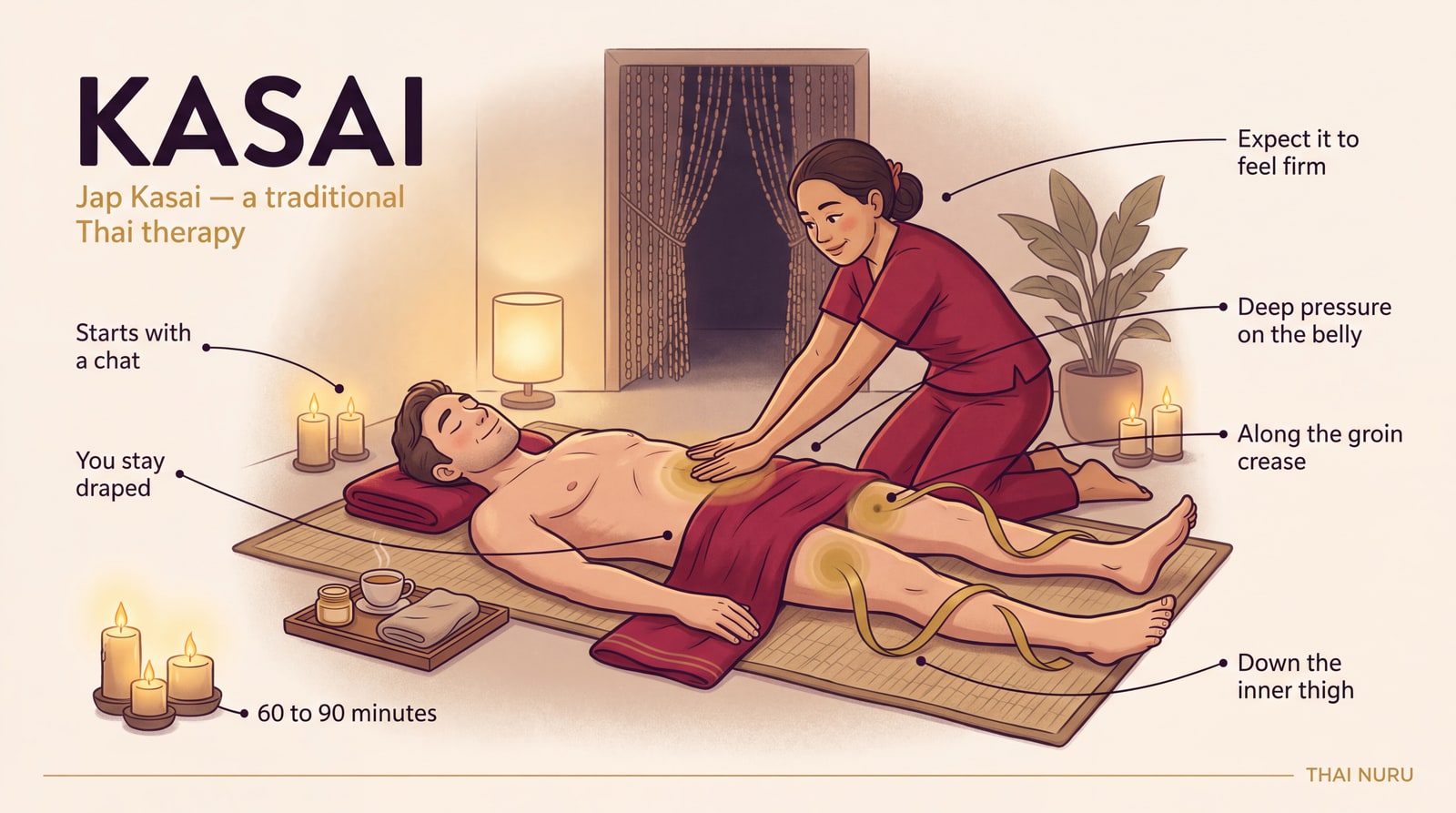
What a kasai session involves
Format varies by teacher, but the shape below is what most Thai practitioners follow and what the venues in our directory describe:
- Consultation. A short conversation about what you are hoping to address and any relevant medical history. A practitioner who skips this entirely is not working in the tradition.
- Abdominal work. The session opens on the belly — slow, deep, static pressure around the navel and the lower abdomen, working outward. This is usually the longest phase and the one that surprises first-timers, because nothing about it is gentle.
- Inguinal and inner-thigh work. Pressure along the crease where the leg meets the torso, and down the adductors. Practitioners describe this as the point of the session.
- Genital and perineal work, where included. Whether this is part of the session depends entirely on the practitioner and the venue, and it is the single thing you should clarify before booking.
Sessions typically run 60 to 90 minutes. The sensation is closer to deep-tissue work than to relaxation massage, and mild soreness the following day is normal and frequently mentioned by practitioners in advance.
Kasai, prostate and lingam massage are not the same thing
These three get used interchangeably online, including by venues that should know better. They are distinct in origin, technique and intent.
| Kasai | Prostate massage | Lingam massage | |
|---|---|---|---|
| Origin | Traditional Thai medicine | Clinical urology; separately, the wellness trade | Western neo-tantra, drawing on Indian tantric vocabulary |
| Primary area | Abdomen, groin, inner thighs | The prostate, reached internally or via the perineum | The penis and surrounding area |
| Stated aim | Releasing blockage along the sen lines | Clinically, obtaining prostatic fluid; commercially, sensation | Extending arousal, breath-led pacing |
| Typical length | 60–90 min | Varies widely | 60–90 min |
| Thai Nuru venues | 4 | 7 | 4 |
In practice, Thai venues selling to foreign visitors blur the categories, and several of the venues below sell more than one of the three. Our prostate massage directory and lingam massage directory cover the other two, and the Bangkok prostate massage guide goes into the Sukhumvit venues in detail. Every format sold in Thailand, wellness and adult alike, is set side by side on our types of massage comparison table.
What kasai costs in Thailand
There is no standard rate, and the spread between venues is wider than for any other service we track. Two things drive it: kasai is usually sold inside a package rather than as a standalone line item, and the venues selling it range from neighbourhood shops to premium Sukhumvit operators.
Rather than quote a national average that would describe none of them, the live entry prices for every kasai venue we list are shown on this page above, pulled from each listing. Where a venue publishes no starting rate at all, we print none — the figure is settled in chat before you arrive, and a number quoted to you second-hand is not a price.
How the venues in our directory sell it
Kasai in our database splits cleanly into two lanes.
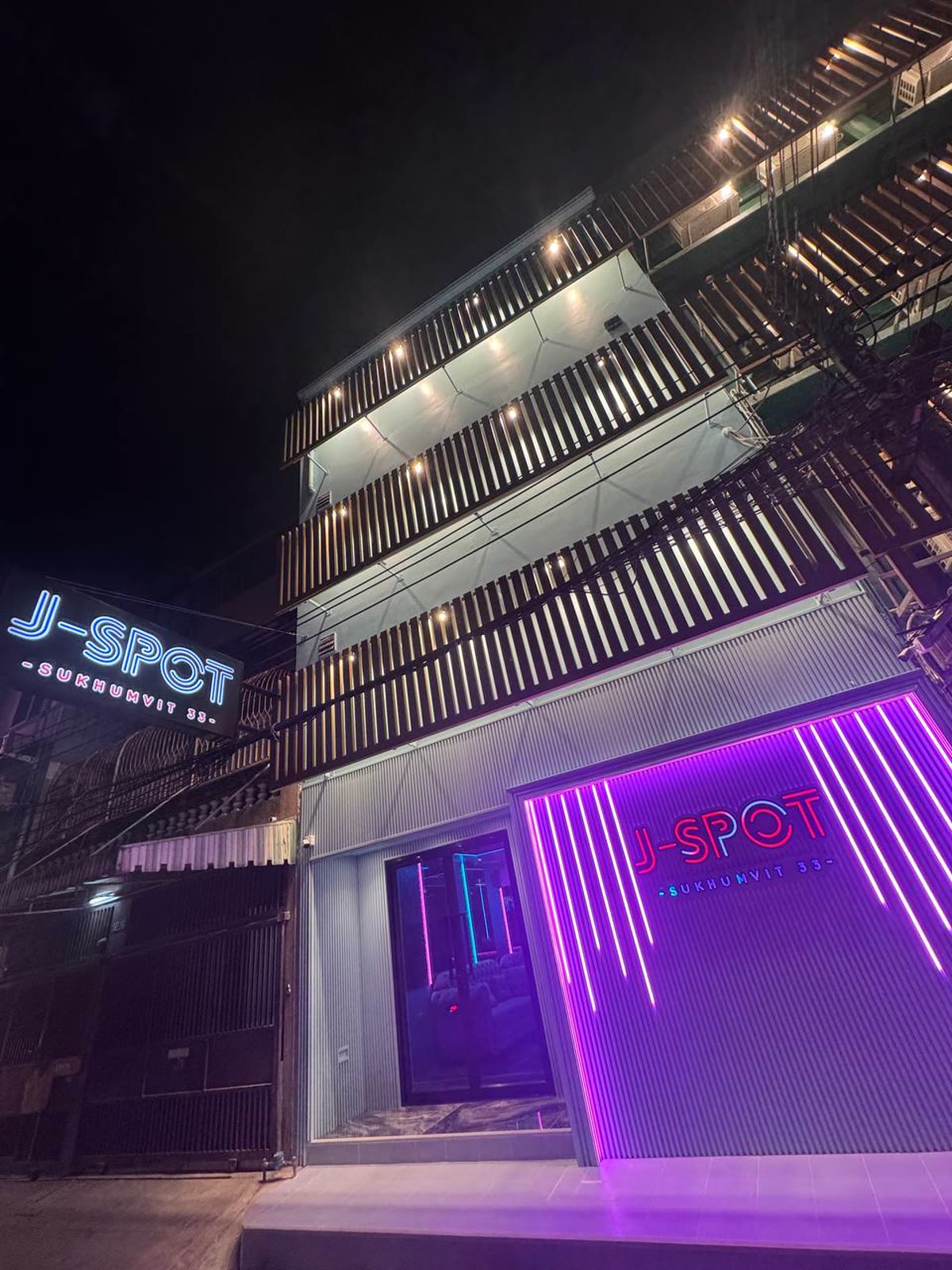
Bangkok, as a premium package component. THE SENSE Bangkok in Asoke builds its signature offer around a 90–120 minute combination of nuru body-to-body and kasai, sold under the Thai name inside named packages rather than as an add-on. It publishes no prices in any channel. J-Spot Bangkok also lists it among its named services.
Chiang Mai, at neighbourhood rates. Dream Massage and MUANHJAIJAI Massage both carry it in Chiang Mai, at a fraction of the Bangkok figures.
Because the 4 venues are split across two cities with no city holding the three listings our directory requires before it generates a city page, there is no per-city kasai directory. That is the rule working as intended rather than an omission: a page built on one or two venues is a thin page, and we do not publish those.
Safety, hygiene and who should not book one
The following is general information, not medical advice. If you have a diagnosed condition affecting the abdomen, prostate, groin or pelvis, ask a doctor before booking any form of deep abdominal or pelvic bodywork.
Kasai involves sustained deep pressure on the abdomen and groin. The situations where that is a genuinely bad idea are reasonably well defined:
- Any acute infection of the prostate or urinary tract. Manipulation of an acutely infected prostate can push bacteria into the bloodstream. In clinical urology, prostatic massage is explicitly contraindicated in suspected acute bacterial prostatitis for exactly this reason — the risk is bacteraemia and, at the far end, sepsis. A massage practitioner cannot assess this. A doctor can.
- Hernia, recent abdominal or pelvic surgery, or an abdominal aortic aneurysm. Deep abdominal pressure is not appropriate over any of these.
- Anticoagulant therapy or a bleeding disorder. Worth clearing with a doctor first.
- Undiagnosed pain. Persistent abdominal, groin, testicular or pelvic pain needs a diagnosis, not a massage. Sudden testicular pain in particular is a medical emergency, not something to book a spa appointment for.
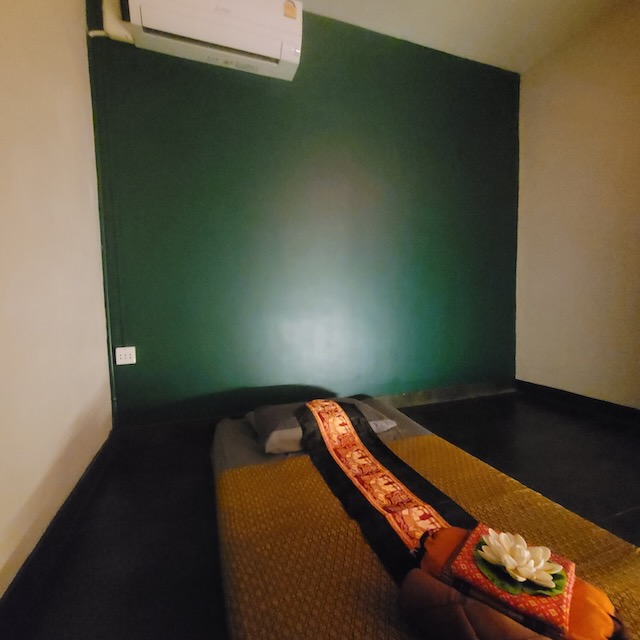
On hygiene, the visible markers are the same ones our safety guidance applies to any close-contact massage: a shower before and after, fresh linens, a clean room, and gloves where there is any internal or genital contact. If a venue does not meet those, leave. You are not obliged to stay because you walked in.
How to book, and what to ask first
Every kasai venue we list books through chat rather than a reservation system — LINE in most cases. Three things are worth settling in that conversation before you travel:
- Agree the all-in figure. Session, room and any add-on. Several of these venues price by room and time rather than by service, and one publishes nothing at all. A screenshot of the agreed number in the chat is your receipt.
- Ask what the session actually involves. This is the one piece of advice the venues themselves give. Kasai is a hands-on technique, the scope varies by practitioner, and the range of what "kasai" means across four venues is wide. Ask directly; nobody will find the question strange.
- Say it is your first one. Practitioners pace the abdominal phase differently for someone who has not had it before.
Tips are customary and separate from the agreed price, in the ฿100–300 range, and should stay distinct from any service fee.
How we verify these listings
Every venue on this page is here because its own published material names kasai as a service it sells. That is a deliberately narrow test, and it is the reason this list is short.
Venues are excluded where the only mention of the word is a cross-link to a neighbouring shop, where the claim traces to an aggregator rather than the operator, or where the framing was ours rather than theirs — during the September 2026 verification pass we removed the tag from a venue that markets kasai but never uses the word "prostate", and from another whose sole "kasai" reference pointed at a different business entirely.
What we do not claim: none of these venues has been visited by our team. Each listing states its own verification status and the date its details were compiled from the operator's published information. Prices shown are the operator's published prices, not prices we have paid. Read the full methodology for how listings enter and leave the directory.