

Prostate Massage in Thailand: The Complete Guide
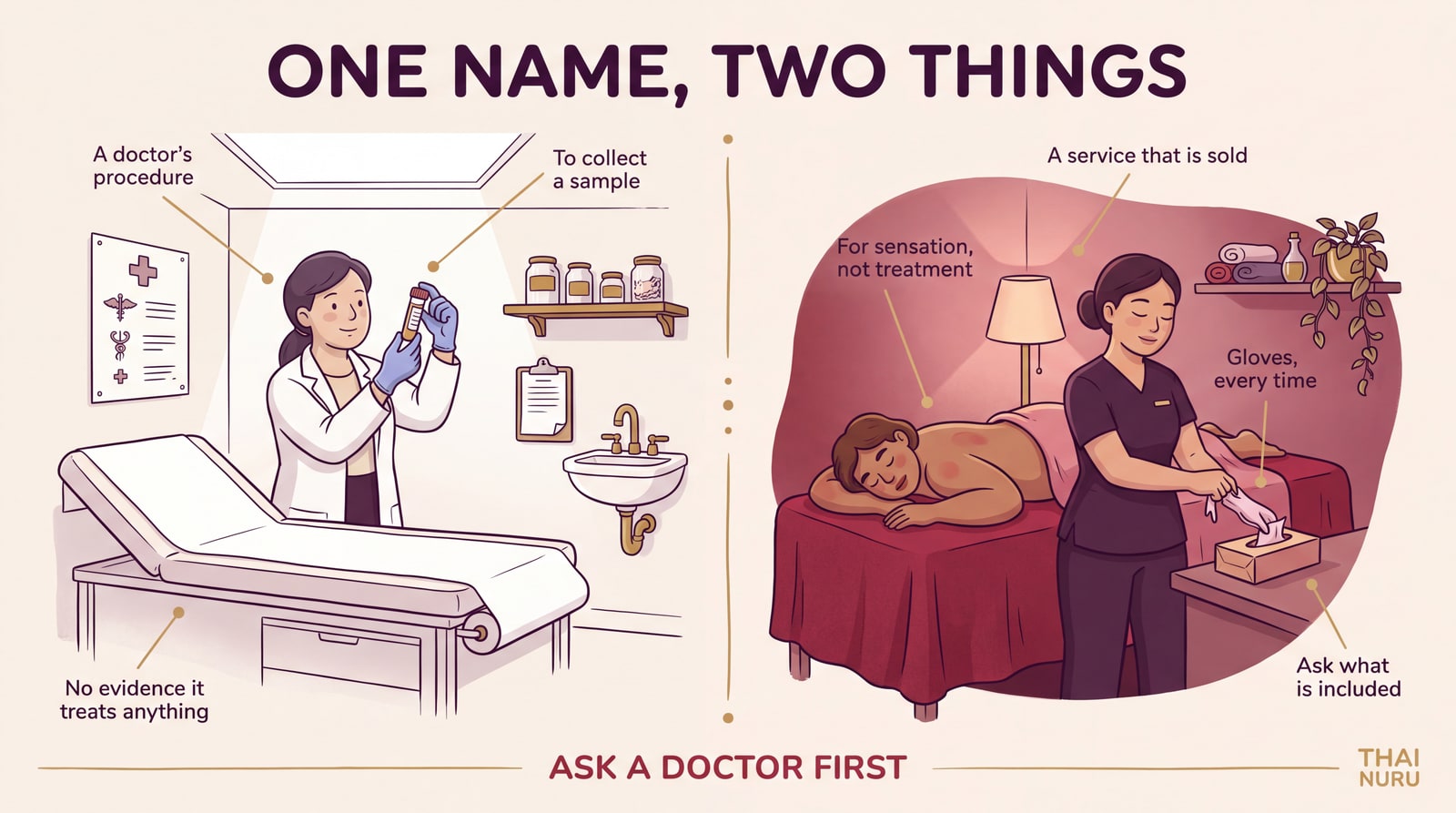
"Prostate massage" names two different things that share almost nothing beyond anatomy. One is a clinical procedure performed by a doctor to obtain a diagnostic sample. The other is a service sold in massage venues. Conflating them is how a great deal of bad information about this subject gets written, including the health claims that appear on venue websites and in the guides that copy them.
This page separates the two, explains what each actually is, sets out the circumstances in which manipulating the prostate is genuinely dangerous, and lists the 7 venues in Thailand whose own published material names prostate massage as a service they sell.
If you are specifically looking for Bangkok venues with itemised menus and published rates, our Bangkok prostate massage guide covers that market venue by venue and is the better page for it. This one is the national picture and the explanation.
The clinical procedure
In urology, prostatic massage is a diagnostic technique. During a digital rectal examination the clinician applies pressure across the prostate to express prostatic fluid into the urethra, where it can be collected and cultured. The sample is called expressed prostatic secretions, or EPS.
It is used mainly to localise infection or inflammation in suspected chronic prostatitis. The classical protocol is the segmented four-glass test — first-void urine, midstream urine, the expressed secretions obtained by massage, and the urine voided immediately afterwards — which lets the clinician work out whether the source is the urethra, the bladder or the prostate. A raised white-cell count in the prostatic fluid, or a large rise in bacterial count relative to the urine samples, points at the prostate.
That is the whole clinical role. It is a sampling technique, performed by a clinician, for a diagnostic purpose. It is not a treatment, and it is not what any massage venue is providing.
When prostate manipulation is genuinely dangerous
General information, not medical advice. Anything in this section that applies to you is a conversation to have with a doctor, not with a massage venue.
There is one contraindication that matters more than all the others combined: suspected acute bacterial prostatitis. Manipulating an acutely infected prostate can force bacteria into the bloodstream, and the consequence is bacteraemia and potentially sepsis. This is well established in clinical practice — it is why urologists perform the rectal examination gently in these patients, avoid the massage-based localisation tests entirely, and diagnose from urine culture instead, which works perfectly well without it.
Acute bacterial prostatitis typically presents with fever, chills, pelvic or perineal pain and painful or difficult urination, often coming on quickly. That combination is a reason to see a doctor, not to book a massage. Other situations that warrant clearing it medically first include a bleeding disorder or anticoagulant therapy, recent prostate surgery or biopsy, known prostate cancer, and any undiagnosed rectal bleeding or pelvic pain.
The people working in the venues on this page are not clinicians and cannot screen for any of this. That is not a criticism of them; it is the reason the screening is yours to do.
What the evidence actually supports
Venue marketing around this service routinely attaches health benefits to it — improved prostate health, reduced cancer risk, relief of prostatitis symptoms. It is worth being direct: the diagnostic use described above is well established, but prostatic massage as a therapy has never accumulated strong evidence, and it is not a standard treatment for prostatitis, benign prostatic hyperplasia or anything else. Where it is mentioned in a therapeutic context at all, it sits at the margins of practice.
We state this plainly because a directory that reprints health claims it cannot support is not a directory anyone should trust. If a venue's copy promises a medical outcome, treat the promise as advertising.
What venues in Thailand actually sell
Setting the clinical picture aside, the commercial service exists, it is clearly advertised, and it is what people searching for it are looking for. Across our directory it appears in three distinct shapes:
- As an itemised service with a published price. The minority. A named session with a stated duration and a stated rate.
- Inside a package. Frequently bundled with nuru body-to-body, and often sold under the Thai name kasai rather than as "prostate massage" at all — two formats our types of massage table separates.
- As one style among many, priced by room and time. The most common shape. The venue lists prostate among a dozen services; the rate card prices the room, not the technique.
That third shape is why the entry prices on this page need reading carefully. At most of these venues the published figure buys a session of a given length in a room of a given grade, and the service you name at booking does not change it. The figure is a floor.
Where it is sold
6 of the 7 venues we list are in Bangkok, concentrated on the Sukhumvit corridor — which is why the Bangkok prostate directory exists as a separate page and no other city reaches the three-listing threshold we require before generating one. The remainder is in Pattaya.
The venue list on this page is the complete national set, with each venue's area, published rate where one exists, and booking channel. For the Bangkok market specifically — including which venue publishes an itemised menu and which publishes no prices at all — the Bangkok guide goes venue by venue.
Hygiene: the part that is not negotiable
Any service involving internal or perineal contact raises the hygiene bar above what a standard massage requires. The markers are visible and you can check them without being an expert:
- Gloves, changed in front of you, for any internal contact. This is the single clearest signal of whether a venue takes the service seriously.
- A shower before and after, with the facility actually available rather than nominally offered.
- Fresh linens on the table, changed between clients.
- Trimmed nails and hand hygiene.
- Single-use or clearly sanitised anything else.
If those are not present, the correct response is to leave and forfeit the booking. It costs less than the alternative.
How to book, and what to ask
- Name the service at booking, not in the room. Most of these venues assign therapists by availability. Prostate work is not offered by every therapist at every venue, and the time to establish that is in the chat.
- Agree the all-in figure. Session, room, any add-on. Several venues here price by room and time and one publishes nothing at all; a screenshot of the agreed number in LINE is your receipt.
- Ask what the session involves. Whether contact is internal, external or perineal varies between venues selling under the same name.
- Say if it is your first. Pacing differs, and practitioners generally ask anyway.
Tips are customary at ฿100–300, separate from the agreed price.
How we verify these listings
A venue is tagged for prostate here only where the operator's own published material names it. That test removed venues during our September 2026 verification pass as well as adding them: one lost the tag because the operator markets kasai and never uses the word "prostate" — the framing was ours, not theirs — and unsourced ratings and contact details were stripped from several listings in the same sweep.
None of these venues has been visited by our team, no price on this page is a price we have paid, and every figure is the operator's own published figure as of the date shown on that venue's listing. Where a venue publishes no rate, we print none rather than estimating one. Our methodology page covers the full standard, including what a paid placement changes and what it does not.