
Thai Oil Massage: What It Is and How It Differs
Oil massage — นวดน้ำมัน, nuad nam man — is the format most Western visitors already have in mind when they say "massage", and it is the one most likely to match that expectation. It is also the format whose name is used most loosely in Thailand, which is where the confusion starts.
The short definition
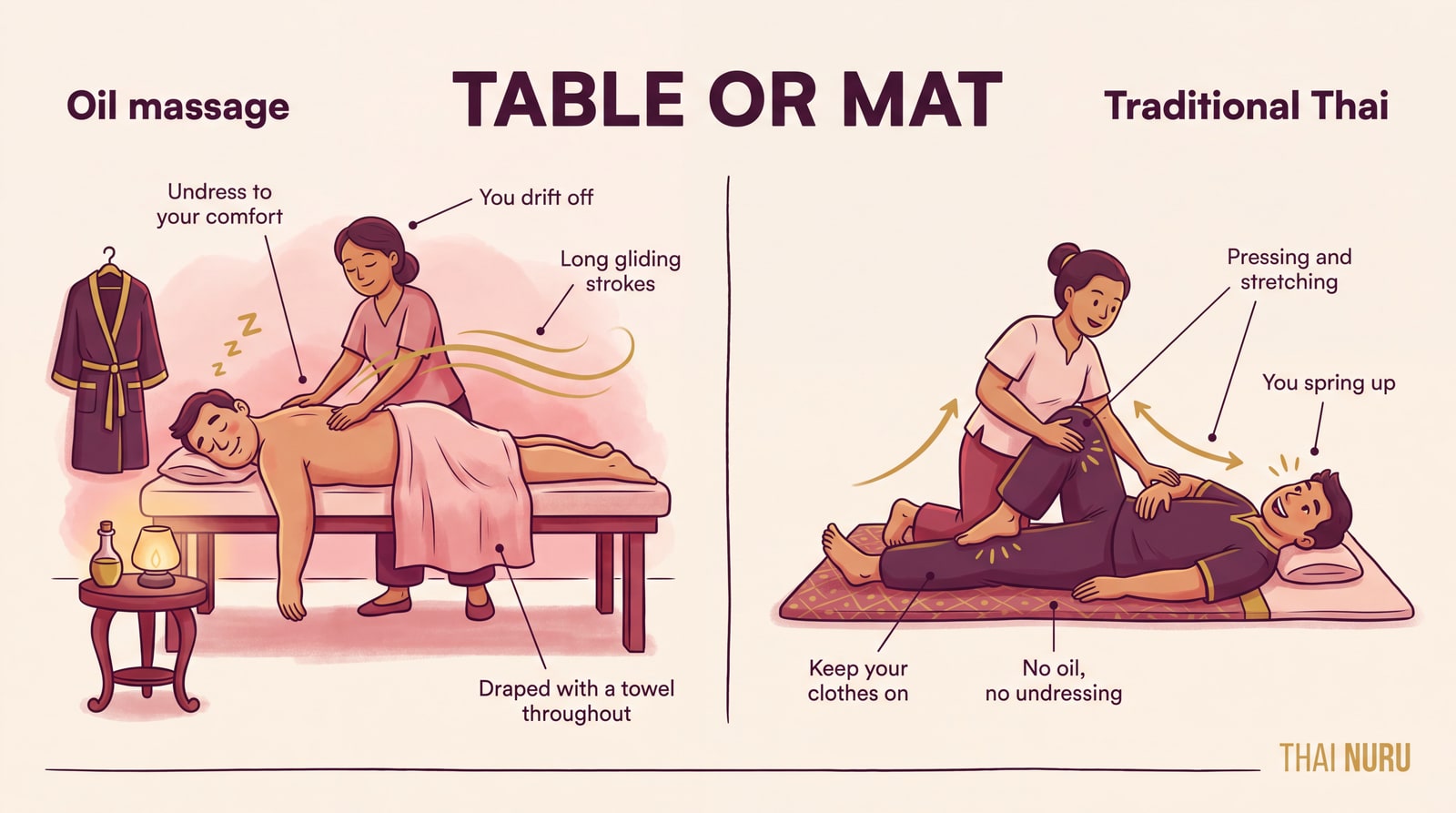
Thai oil massage is a table-based massage using oil as a lubricant, worked with long gliding strokes, kneading and circular thumb pressure. You undress to your comfort level and are draped with a towel or sheet throughout, with only the area being worked uncovered. A session runs 60 to 90 minutes.
Mechanically it sits much closer to Swedish massage than to traditional Thai massage. Most Thai therapists trained in it learned both, and many shops sell both from the same menu, but they are genuinely different techniques with different aims.
Oil massage against the traditional format
| Oil massage | Traditional Thai | |
|---|---|---|
| Where | Table | Floor mat |
| Clothing | Undressed, draped | Fully clothed in provided cotton |
| Oil | Yes | None |
| Technique | Gliding strokes, kneading | Static compression, assisted stretching |
| Your role | Passive throughout | Moved and positioned by the therapist |
| Feels like | Relaxation, sedating | Worked-over, energising |
| After-effect | Drowsy | Loose, occasionally sore |
If you want to fall asleep, book oil. If you want to be able to touch your toes afterwards, book traditional.
What a session involves
- Shower first at most venues, which is standard and expected rather than a hint.
- You undress to your comfort level — usually to underwear — and lie under a towel while the therapist steps out or turns away.
- Draping is continuous. Only the limb or section being worked is uncovered, and it is re-covered afterwards. A therapist working to standard will do this without being asked.
- Back first, usually, then legs, then you turn over for the front of the legs, arms, and often the shoulders, neck and scalp.
- Pressure is adjustable and the same vocabulary applies as anywhere else in Thailand: bao bao for lighter, raeng raeng for firmer, jep for that hurts.
The oils actually used
Most shops work with a plain carrier oil — coconut is the commonest in Thailand, along with sesame, rice bran and grapeseed. Coconut absorbs quickly and smells faintly of nothing much, which is why it is the default.
If the oil is scented with essential oils, the treatment is usually sold as aromatherapy massage at a higher price. The technique is identical; what you are paying for is the blend and, at a spa, the room.
Two practical points. Tell the therapist about any nut allergy before the session, since some blends use almond or other nut-derived carriers. And oil comes out of hair and off skin easily but is less forgiving of clothing — a great many visitors discover this on the walk home.
Why the name is used loosely
This is the part a guide to Thailand has to address honestly. "Oil massage" is a legitimate, extremely widespread wellness treatment, sold in hotel spas, shopping-mall chains, hospital wellness centres and thousands of ordinary neighbourhood shops. The overwhelming majority of oil massage in Thailand is exactly what it says.
It is also the phrase some adult venues use on their menus, because an oil massage on a table is the base format that several adult services are built on top of. The result is that the same two words describe both a hotel spa treatment and something quite different a few streets away.
Telling them apart is not difficult in practice. A therapeutic shop displays its licence and its price list, prices by duration alone, and is frequently open to the street. A venue selling adult services prices by room and time, publishes no itemised menu or publishes one that names other services, and generally books through chat rather than walk-in. Where you are unsure, ask what is included before you commit — the answer settles it immediately.
Thai Nuru is a directory of adult massage venues, so we do not list oil massage shops. This page explains the format because the word appears on both sides of that line and the distinction is worth being able to make.
What it costs
We publish no price range for oil massage, because we list no oil massage venues and a range we have not verified is a number invented for the sake of having one. What is safe to say is the shape of the market: neighbourhood shops price by the hour and hotel spas cost several times that for the same technique in a better room.
Where we do publish prices — on the adult venues in our directory — every figure is the operator's own published rate, dated on the listing. See our methodology for how that works.
Who should take care
Oil massage is gentler than the traditional format, but tell the therapist before the session about recent surgery, any skin condition or open wound, a blood-clotting disorder or anticoagulant therapy, varicose veins, or pregnancy — several shops decline the first trimester as a matter of policy, and pregnancy massage is a separate speciality. Sharp pain is always a reason to stop rather than endure. General information, not medical advice.
Where to go next
The types of massage in Thailand table puts every format side by side. If the scented-oil spa version is what you had in mind, aromatherapy massage covers it; if you want two therapists, four-hands massage explains what that actually changes.