
Tantric Massage: What's Real and What's Marketing
No term in Thailand's massage market carries more borrowed authority than "tantric". It suggests an ancient Indian lineage, an initiated practitioner and a spiritual framework. The practice sold under the name is a twentieth-century Western construction, and a guide that wants to be trusted should say so before describing it.
That does not make the format worthless. It makes the marketing around it worth reading carefully.
The short definition
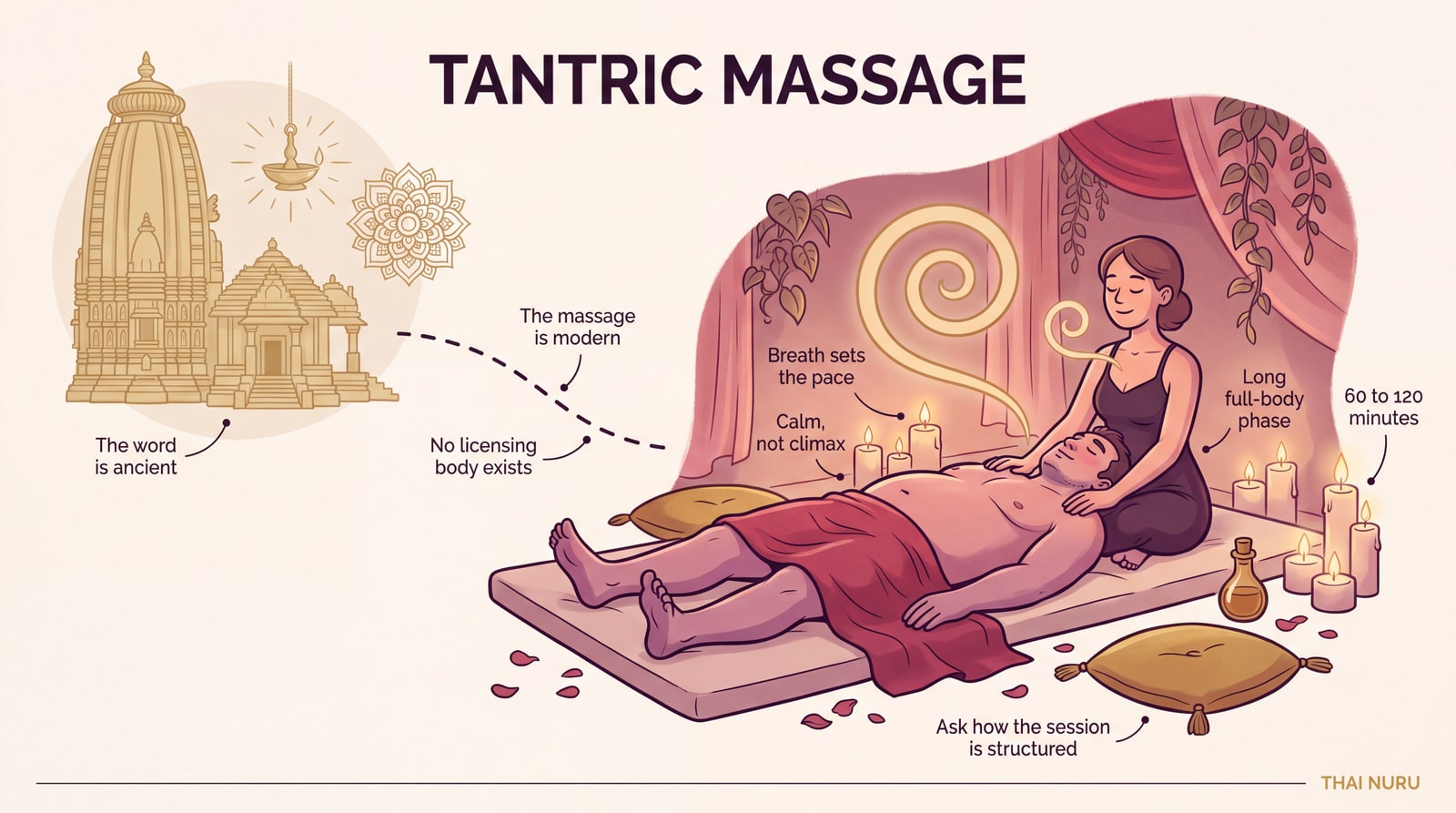
Tantric massage, as sold, is a full-body oil session built around breath, slow pacing and extended arousal rather than a conclusion. Lingam massage and yoni massage are named techniques within it. Sessions run 60 to 120 minutes, and in the format as taught the majority of that time involves no genital contact at all.
Where tantra actually comes from
Classical tantra is a body of Hindu and Buddhist esoteric practice that emerged in India from around the sixth century CE. It is largely concerned with ritual, mantra, visualisation, deity practice and initiation transmitted through a teacher. Sexual practice appears within some of its currents, as one strand among many, and is hedged with restrictions.
Structured genital massage sold by the hour is not part of it. There is no classical tantric text describing the treatment a Bangkok venue offers under the name.
What is sold today descends from neo-tantra: a Western movement that took tantra's vocabulary and applied it to a programme centred on sexuality, intimacy and breath work. It spread through the Western workshop and publishing circuit across the 1980s and 1990s, entered the international spa trade, and reached Thailand from there.
The honest lineage of a "tantric massage" in Bangkok is therefore: Sanskrit vocabulary, Western technique, Thai commercial venue. Each link is real. The chain is not what the word implies.
What a session involves
In the format as taught, the structure is deliberate and the pacing is the entire point:
- Breath first. Guided breathing before any touch, intended to shift the recipient out of a goal-directed frame.
- A long full-body phase. Oil work across the back, legs, abdomen and chest. In the tradition this is not a warm-up — it is most of the session.
- Named genital techniques where included, paced against the breath, with the stated aim of extending arousal rather than concluding it.
- Stillness at the end, rather than an abrupt finish.
Practitioners working in the format typically ask for a conversation about boundaries beforehand and check in during. A session with no such conversation is not being run in the tradition, whatever it is called.
How Thai venues use the word
Here is the part worth knowing before you book. In Thailand, "tantric" appears on menus in three quite different situations:
- As a genuine format — a small number of practitioners deliver something recognisably close to the taught version.
- As a premium label on a longer oil session, where the word signals price and duration rather than method.
- As a synonym for an adult service, with the spiritual framing supplying nothing but the name.
All three are advertised in the same vocabulary, and the menu will not tell you which you are looking at. The conversation at booking will. A venue that can describe how the session is structured, how long the full-body phase runs and what the breath work involves is describing something it actually does; a venue that answers in adjectives is selling you the third thing.
Reading the marketing
A few claims recur often enough to flag:
- "Ancient technique passed down through generations." The technique is modern. The vocabulary is old.
- "Certified tantric practitioner." There is no licensing authority for this. Certificates come from private schools setting their own standards, which vary from serious to nominal.
- "Kundalini awakening", "energy blockage release", "chakra alignment." Framework language from the neo-tantric tradition. Not claims that can be verified, and not grounds for a premium.
- "Tantric healing" for a named medical condition. Treat as advertising. Anything you would see a doctor about remains a matter for a doctor.
None of this means a session will be poor. Breath-paced, unhurried, full-body massage is a real and pleasant thing. It is simply not what the cosmology on the website claims it is.
Consent and boundaries
This format involves more discussion of boundaries than any other, and that is a feature of it rather than an awkwardness.
Agree at booking what the session includes. A therapist's consent matters exactly as much as yours, and a request made once a session has started — for something not agreed at the desk — is the most common way a straightforward booking becomes an incident. Ask in the chat, before you arrive. And any doubt about a person's age ends the booking; that is not a judgement to work through in the moment.
The legal position
Massage establishments in Thailand are licensed under the Entertainment Places Act B.E. 2509 (1966). Prostitution is separately prohibited under the Prevention and Suppression of Prostitution Act B.E. 2539 (1996), which defines the offence broadly and criminalises running or procuring within a prostitution establishment. Thai Nuru is an editorial directory: we report what operators publish about themselves, with sources and dates, and we broker, arrange and verify nothing beyond that.
Where to go next
The two named techniques within the format each have their own page: lingam massage, with the venues in our directory that advertise it, and yoni massage. For the traditional Thai practice that is genuinely old — and frequently confused with this one — see kasai. Everything side by side on the types of massage in Thailand table.