Traditional Thai Massage: What It Is, and What It Isn't
Traditional Thai massage — นวดแผนไทย, nuad phaen thai, also called nuad boran or "ancient massage" — is the foundation of everything else sold as massage in Thailand. Understanding it is the fastest way to understand the rest of the market, because almost every other format on offer is either a variation on it, a Western import sitting alongside it, or an adult service borrowing its vocabulary.
It is also the format most often mis-sold to visitors, who book it expecting a spa treatment and find themselves being folded in half on a floor mat.
The short definition
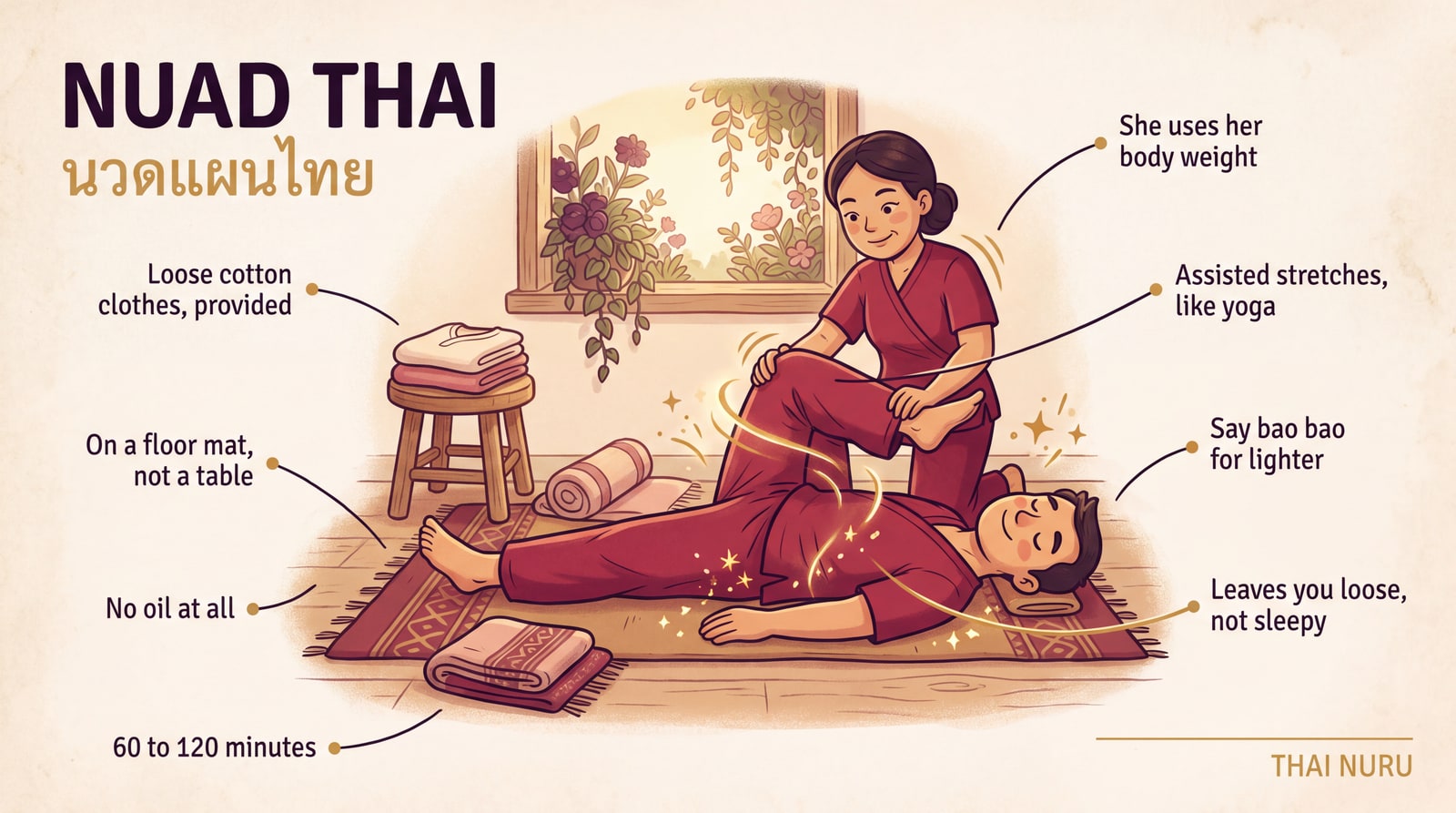
Traditional Thai massage is a clothed, oil-free bodywork system performed on a firm mat on the floor. The therapist applies rhythmic compression along the body's sen lines using thumbs, palms, elbows, forearms, knees and feet, and moves the recipient through a sequence of assisted stretches. A session runs 60 to 120 minutes and covers the whole body.
No oil. No table. No undressing. If any of those three things are happening, you are not having a traditional Thai massage — you are having something else, which may be perfectly good but should be named accurately.
The sen line system
Thai massage rests on a theoretical model of energy channels called sen, understood to run throughout the body. Tradition counts some 72,000 of them, of which ten — the sib sen — are treated as primary and are the ones a practitioner actually works. Illness and discomfort are framed as obstruction of flow along these lines, and the treatment as rebalancing it.
This is a traditional model rather than an anatomical one, and it is worth saying so directly: the sen lines do not map onto nerves, blood vessels or lymphatics, and nothing in the practice requires that they should. It is the framework the technique is taught and transmitted through, and the technique itself — sustained compression plus assisted stretching — produces effects a physiotherapist would recognise regardless of the model used to describe them.
Wat Pho, and what the recognition actually means
The principal centre of Thai massage learning is Wat Phra Chetuphon in Bangkok, universally known as Wat Pho. Stone inscriptions installed there during the reign of King Rama III include diagrams of the sen lines, and the temple's school remains the reference institution for the practice.
In December 2019, at the fourteenth session of its safeguarding committee in Bogotá, UNESCO inscribed Nuad Thai on the Representative List of the Intangible Cultural Heritage of Humanity. The announcement was made at Wat Pho.
Worth being precise about what that recognition is, because venue marketing routinely overstates it: it is cultural-heritage recognition of a practice and its transmission. It is not a medical endorsement, it does not certify any particular shop, and a venue displaying "UNESCO" on its window is telling you nothing about itself.
What a session actually involves
- You change into loose clothes. Cotton pyjama-style trousers and a wrap top, provided by the venue. You keep your underwear on.
- You lie on a mat on the floor. Firm, usually with a thin cushion. Some venues use a low platform.
- The work starts at the feet. Compression up the legs with thumbs and palms, following the sen lines, in a slow rhythm.
- Then the stretching. Legs rotated and drawn toward the chest, the torso twisted, the back opened. If you have done yoga the shapes will be familiar — the common description is that the therapist does yoga on you.
- Then arms, hands, shoulders, neck and head, often finishing seated.
- The therapist uses body weight, not muscle. They will lean, kneel on the mat beside you, brace against you, and at some venues walk on your back. This is normal technique.
It is not a relaxation treatment in the Western sense. It is vigorous, it can be uncomfortable, and it is common to feel worked-over for a day afterwards in the same way as after a hard stretch session.
Asking for the pressure you actually want
The single most useful thing a visitor can learn is how to modulate pressure, because the default at a local shop is firmer than most first-timers expect.
- "Bao bao" (เบา ๆ) — lighter, please.
- "Raeng raeng" (แรง ๆ) — stronger, please.
- "Jep" (เจ็บ) — that hurts. Say it immediately; Thai therapists respond to it without any offence taken.
Say something the moment pressure crosses from intense into painful. Enduring it silently is not politeness, and a good therapist would rather be told.
Where it is taught and licensed
Therapeutic massage in Thailand sits under a licensing regime administered through the public health authorities, with training delivered by accredited schools — Wat Pho's among the best known. A licensed therapeutic massage shop and an adult venue are different categories of business operating under different rules, whatever the similarity of the signage.
That distinction is the reason this page exists on a directory that does not list traditional Thai massage venues. We cover the adult side of the market. Traditional Thai massage is explained here because it is the reference point everything else is measured against, and because a visitor who cannot tell the two apart is the visitor most likely to walk into the wrong shop.
How it relates to everything else on this site
| If you want… | Ask for | What changes |
|---|---|---|
| The traditional format | Thai massage, นวดแผนไทย | Clothed, floor mat, no oil |
| Something gentler and passive | Oil massage | Table, draped, gliding strokes |
| Scented oils and a spa setting | Aromatherapy massage | Oil massage with essential oils |
| Two therapists at once | Four-hands massage | A staffing format, any base style |
| Foot work only | Foot massage, นวดเท้า | Seated, 30–60 min, widely available |
The adult formats — nuru, soapy, happy ending and the rest — are a separate market with separate venues, and the types of massage comparison table sets all of them side by side.
One practical warning
Assisted stretching applies real force to joints and the spine. Tell the therapist before the session if you have a back or neck injury, a disc problem, osteoporosis, recent surgery, high blood pressure, or if you are pregnant — several stretches are routinely modified or dropped in those cases, and a good therapist will ask. If a stretch produces sharp or radiating pain rather than the ache of a stretch, say so and stop it. This is general information rather than medical advice; anything ongoing is a question for a doctor.